Products


Carbon dioxide is an odourless, colourless and tasteless gas. It is a very stable molecule and, a priori, it is not a toxic gas, but it can become asphyxiating by displacing oxygen in very high concentrations.
The measurement of CO₂ is a good indicator for assessing the indoor air quality of a space and its air renewal rate.
The ranges for green, yellow and red limits used in the MICA device are based on recognized references such as the Global Open Air Quality Standards (GO AQS), international certifications like WELL and RESET and recent indoor air quality-related scientific publications (Morawska et al., 2024; Lowther et al., 2021). These frameworks define relevant criteria for assessing indoor ventilation and evaluating how different parameter concentrations affect comfort and occupant well-being.
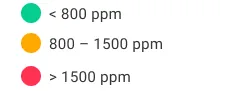
Parts per million (ppm) is a unit of concentration measurement that measures the number of units of a compound or substance per million units of the whole.
CO₂ is emitted by humans and animals in the breathing process. It also results from the combustion of any carbon-containing substance, so poorly sealed stoves or other indoor combustion processes, or over-occupancy without adequate regulation of air renewal, often increase CO₂ levels.
An indoor space with low CO₂ levels is representative of a space with adequate air renewal. Fresh air has CO₂ levels of around 400 ppm.
High CO₂ levels sustained over time lead to fatigue, malaise, increased respiratory rate, drowsiness, lack of concentration and decreased productivity.
The main recommendation is ventilation, which should be proportional to the rate of CO₂ production inside, mainly due to the occupation of people and animals or the presence of combustion systems (cookers, fireplaces, cookers, etc.).
If there are boilers or cookers indoors, it is recommended that they are as airtight as possible, facilitate the supply of direct outside air and keep the draught high when they are switched on.
Morawska, L., et al. (2024). Mandating indoor air quality for public buildings. Science, 383, 1418–1420. https://doi.org/10.1126/science.adl0677
Lowther, S. D., Dimitroulopoulou, S., Foxall, K., Shrubsole, C., Cheek, E., Gadeberg, B., & Sepai, O. (2021). Low Level Carbon Dioxide Indoors—A Pollution Indicator or a Pollutant? A Health-Based Perspective. Environments, 8(11), 125. https://doi.org/10.3390/environments8110125