Products


Indoor air quality monitoring starts working as one more component within the building automation infrastructure, interacting with the rest of the devices connected to the system.
inBiot had already worked with Siemens on a project with Siemens Switzerland and Pictet Group: 65 MICA WELL units connected via Wi-Fi for data transmission and visualisation, and Modbus RTU for direct communication with the BMS.
With Connect Box, the scenario is different. We are talking about an intelligent gateway that supports 11 protocols and works with more than 800 devices from 150 manufacturers. By integrating MICA here, air quality stops living in a parallel system and coexists with HVAC, lighting, energy metering and access control within the same management environment.
MICA transmits its readings via LoRaWAN. Connect Box receives them, decodes them and incorporates them into the system. The device appears as any other element of the installation.
During validation, Modbus was also used for verification and comparative studies. Both channels operate simultaneously, which allows communication architectures to be designed with redundancy or with different levels of data access depending on project needs.
MICA already supports LoRaWAN, BACnet and Modbus RTU/TCP natively, three of the protocols supported by Connect Box. No intermediate gateways or adapters have been required. It fits directly.
This is probably the most relevant point. Until now, MICA covered LoRa, NB-IoT, Sigfox, Wi-Fi, Ethernet, Modbus and BACnet. With Connect Box as a bridge, it also accesses the KNX ecosystem, one of the most widespread building automation standards in Europe, without modifying hardware or firmware.
For any project where the main field bus is KNX, this opens up a route that did not exist before.
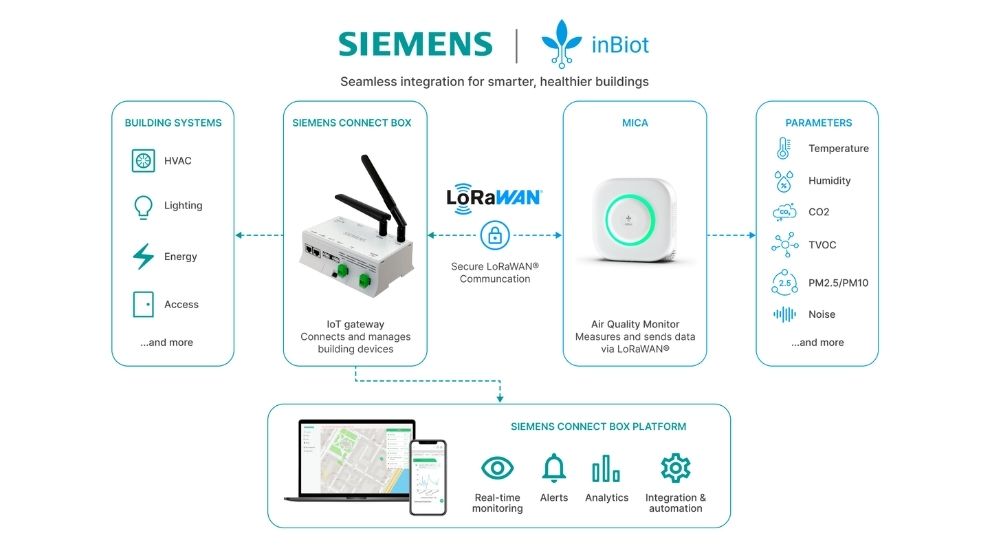
A building managed with Connect Box already has visibility over energy consumption, equipment status and operating conditions. Adding data on CO₂, temperature, relative humidity, total VOCs, particulate matter (PM2.5, PM10) and ambient noise completes that picture and turns it into actionable information.
CO₂ data makes it possible to adjust HVAC according to real occupancy. Particulate matter and volatile organic compound levels report on what occupants are breathing. In a context where the European EPBD directive and certifications such as WELL v2 require continuous monitoring, having these parameters already integrated into the building management system simplifies regulatory compliance and reporting.
This is not about adding one more sensor. It is about air quality having the same operational weight as supply air temperature or electrical panel consumption.
During development, compatibility with Wattsense IoT gateways was also verified. Wattsense is the manufacturer of the hardware on which Connect Box is based and markets its own line of devices with equivalent functionality. The integration operates in the same way in both environments, expanding deployment options for integrators and facility managers.
Each MICA offers LoRaWAN, NB-IoT/LTE-M, Wi-Fi, Sigfox and Ethernet as connectivity options, together with Modbus RTU/TCP and BACnet as industrial communication protocols. Data is also available on the My inBiot cloud platform and accessible via API.
It is the device that adapts to the building, not the other way around. And now, with Connect Box, KNX closes the last gap that remained in that list.