Products


The new European Energy Performance of Buildings Directive (EPBD), formally adopted as Directive (EU) 2024/1275, marks a turning point in the way buildings are designed, renovated and, above all, operated across Europe. In the context of the energy transition and decarbonisation, the regulation expands its focus: it is no longer sufficient to design energy‑efficient buildings; it is now essential to demonstrate their real performance once they are in use.
With this directive, the European Union reinforces a key idea for the sector: energy efficiency, indoor comfort and environmental quality are part of the same system and must be managed together, on a continuous basis.
The Energy Performance of Buildings Directive is the regulatory framework that guides EU Member States in improving the energy performance of the European building stock. With the approval of Directive (EU) 2024/1275, the EU sets a clear long‑term objective: to achieve a zero‑emission building stock by 2050.
To reach this goal, the directive on the energy performance of buildings addresses the entire building lifecycle, from design and construction to renovation, operation and maintenance. One of the most significant shifts introduced by the epbd directive is that energy performance is no longer assessed only on paper. The real behaviour of the building, under normal conditions of use and occupancy, becomes a central element.
The new EPBD introduces structural changes that affect both new and existing buildings:
The directive reinforces the energy renovation of the existing building stock as one of the main mechanisms to reduce emissions and improve the overall performance of buildings.
It is no longer sufficient to design energy-efficient buildings. The regulation requires that this efficiency is maintained over time, which implies greater control of technical systems and the ability to identify deviations between expected and actual performance.
The EPBD recognises the strategic role of automation, control and monitoring systems in managing increasingly complex buildings. The availability of reliable data becomes a practical requirement to demonstrate regulatory compliance.
Although it is a technical regulation, its impact is transversal. The EPBD directly affects:
All of them share the same need: to be able to demonstrate, with data, that buildings operate in line with the established energy efficiency objectives.
One of the most significant changes introduced by the new energy performance of buildings directive is the shift from one‑off compliance to continuous performance. The EPBD highlights the importance of understanding how a building behaves in day‑to‑day operation.
This represents a change in the way buildings are managed. Decision‑making based on assumptions or isolated audits gives way to approaches supported by real, continuous data. This enables better anticipation of issues, optimisation of technical systems and clearer justification of operational decisions.
In this context, indoor comfort and environmental conditions are no longer secondary aspects. They become part of the overall performance of the building, reinforcing the link between energy efficiency and the quality of the indoor environment.
Directive (EU) 2024/1275 sets the common European framework, while its practical application depends on national transposition by each Member State. The main milestones are as follows:
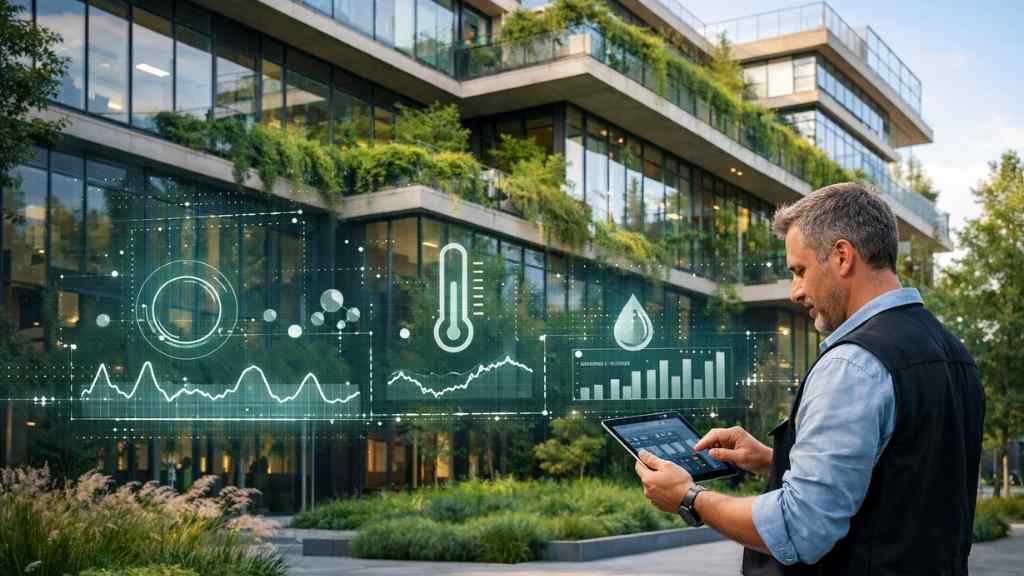
One area that gains increased relevance under the new Energy Performance of Buildings Directive is the direct relationship between energy efficiency and indoor air quality. As buildings become more airtight in order to reduce energy losses, controlling indoor environmental conditions becomes increasingly critical.
Poorly managed ventilation can negatively affect occupant comfort, health and, ultimately, the overall performance of the building. For this reason, the epbd directive implicitly reinforces the idea that an energy‑efficient building cannot be assessed solely on energy consumption, but on how it performs in real use, including the quality of the indoor environment.
This drives a clear shift from occasional assessments to continuous monitoring based on data, positioning indoor air quality as an operational indicator that supports better building performance over time.
Adapting to the new energy efficiency directive is not only about meeting regulatory requirements, but about having continuous visibility into the building’s real performance. This is where monitoring indoor air quality and environmental conditions plays a key role.
inBiot solutions enable the continuous measurement of fundamental parameters such as CO₂, temperature, humidity and particulate matter, providing an objective view of how the building behaves under real operating conditions. These data make it possible to:
Through the My inBiot platform, building managers can consult and analyse data in real time, enabling more transparent, efficient and EPBD-aligned building management.
In a context where regulation increasingly requires proof of continuous building performance, measurement and intelligent use of data are no longer optional. Integrating indoor air quality into the building management strategy is a key step to comply with the new EPBD and move towards more efficient, healthier and future-ready buildings.